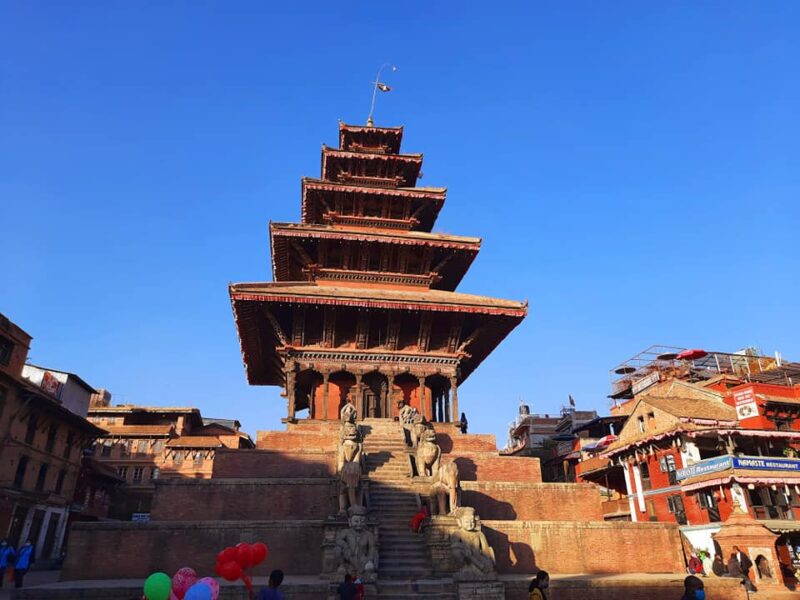
Nyatapola Temple: Bhaktapur’s Iconic Five-Story Pagoda
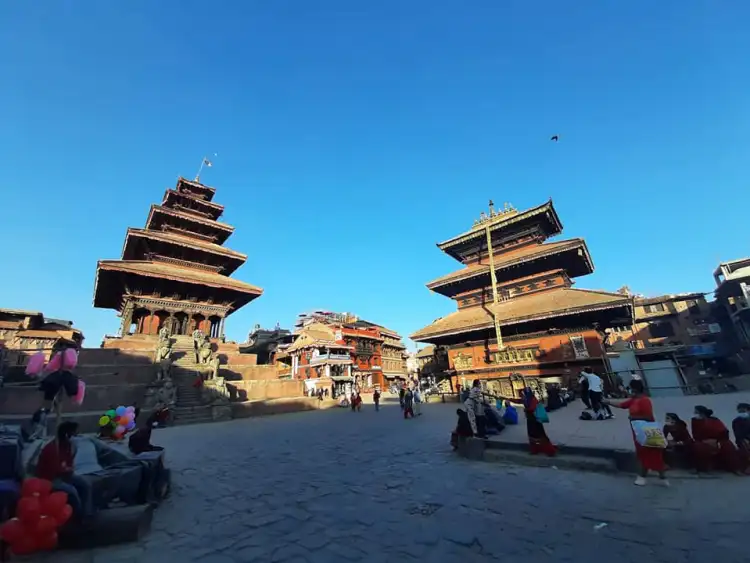
Ngatapola (Nyatpol) Temple, Bhaktapur is located in the Taumadhi area of Bhaktapur. It was built in the 18th century by King Bhupatindra Malla of the Malla dynasty. This temple has five floors. This temple is the temple of Siddhilakshmi. The goddess is also considered to be the embodiment of Tantric power.
This temple is believed to have been built in just seven months. It is mentioned that the residents of Chhaling, Jitpur, Bageshwori, Sakwa, Jhaukhya, Changu, Gokarna, Panti, etc., also helped in the construction of this temple.
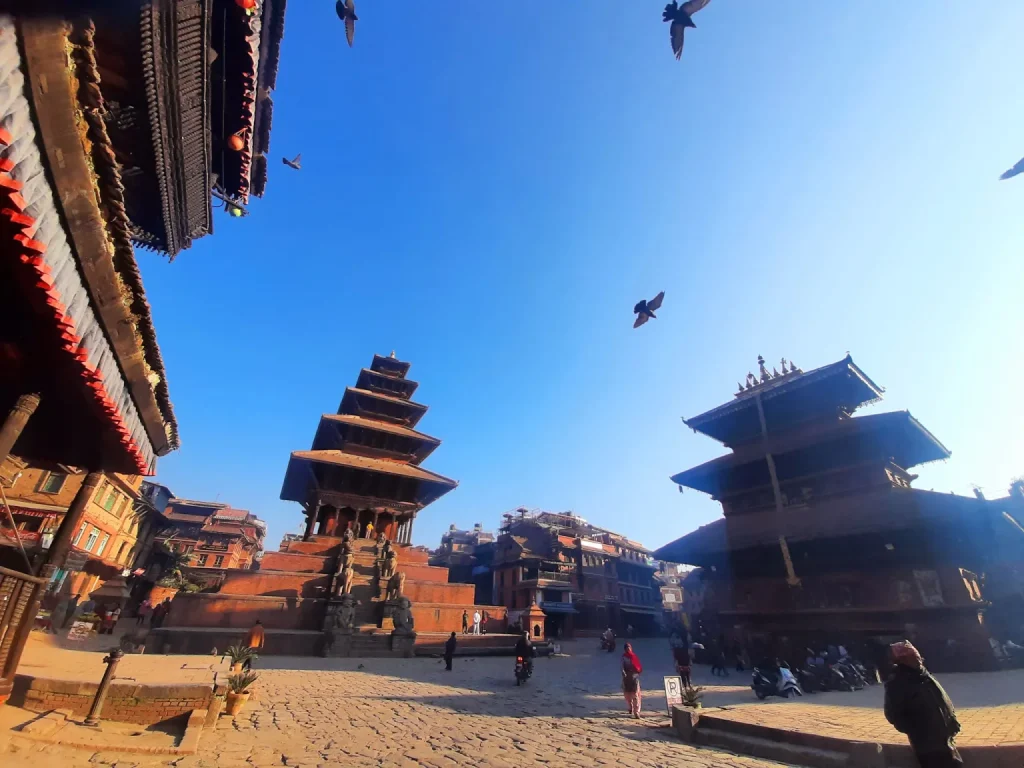
In the absence of good relations with the kingdoms of the valley, King Bhupatindra Malla built this temple as soon as possible to demonstrate his power and invited all the people of Bhaktapur and the kings of neighboring kingdoms to the feast.
About 23 thousand people were present at this feast, which was 4 times the population of Bhaktapur. This is the tallest (108 feet, 33.23 meters) Nepali-style temple in Nepal.
It was built by the then King Bhupatindra Malla of Bhaktapur during a period of 6 months from 822 Katik to 822 Jestha.
Unlike other temples, this temple is not open to the general public except for the priest and designated persons to perform puja. The temple is never open. Inside, there is an artistic statue of Siddhilakshmi carved in stone.
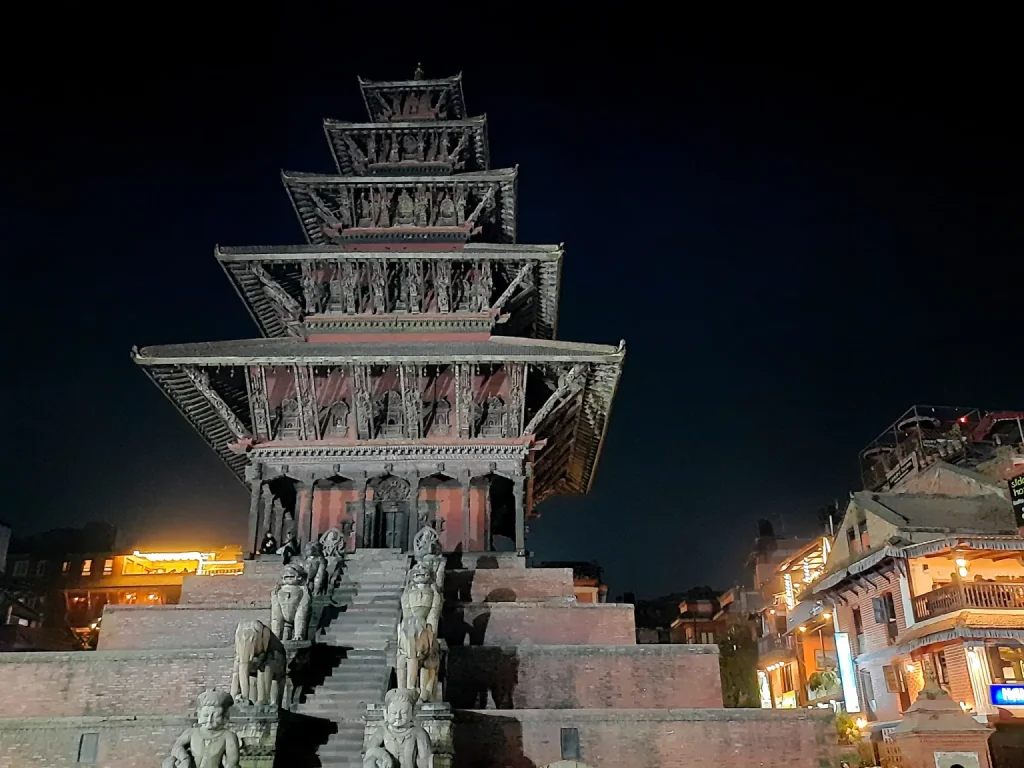
Architecture of the Nyatapola temple
Architectural historian Wolfgang Korn classifies the Nyatapola Temple as belonging to the “F-type” style, with a colonnade completely enclosing the interior brick walls. In this respect, the temple is similar to other temples in the valley, such as the Uma Maheshwar Temple in Kirtipur.
From the front, the colonnade rests on a scalloped “arch,” supported by a sturdy (approximately 25 cm high) wooden beam that ensures structural stability. Although difficult to discern today, the beam was once painted with floral and vegetal motifs.
The beam joints are obscured by small carvings of deities above the highest point of the “arch.” Bernier notes that the entire complex is “stylistically unique” (Bernier, p. 104). The cornice at the top of the beam is carved with a wavy band pattern, and the projecting beam ends above the band are carved with images of pouncing tigers and other ferocious animals. Higher up, toothed moldings provide a base for the uppermost brickwork, which supports the walls and overhead supports.
Numerous carved wooden brackets support each roof tier. Each bracket typically contains a three-dimensional, multi-armed deity standing atop a lower tier, which in turn depicts one or more other deities in various poses. Each main bracket is flanked by secondary brackets for additional support. These are carved into overlapping, scalloped leaves, resembling snake scales. Each composition was apparently once painted in vibrant colors, but only faded traces of the original color can be discerned today.
Each roof tier follows the same form, but the number of brackets decreases from six per side (at the bottom tier) to two per side (at the top tier).
The roof and bracket structure is supported by a heavy brick core, which widens and tapers toward the base. The lower brick core is decorated in typical Newar style, with a doorway consisting of a broad beam flanked by quarter-circular panels and flanked by blind windows. There are no formal windows, and the door is always locked to ensure privacy.
The interior space was likely only available on the ground floor, meaning that whatever Tantric rituals took place in the tiny, womb-like chamber would have occupied very little space, likely unable to accommodate more than a dozen priests.
Why is Nyatapola always closed?
This temple is dedicated to Goddess Siddhi Lakshmi. But most people don’t know what she looks like. Only the priests who have the opportunity to enter the temple know about her form.
However, pieces of evidence suggest that her face is definitely extreme. Her black-shadowed idol has 9 heads and 18 arms. First of all, she is said to be accompanied by Masana Bhairava and Mahakal Bhairava. The idol was prepared according to extreme Tantric rituals.
Perhaps that is why she is not available to the common people. However, the images carved on the temple walls can be appreciated as less cruel incarnations of the passive deity.
Nyatapol’s Dhars
However, the temple doors are opened by the priests only during Dashain and Pancha Prachar Puja. Apart from this, daily pujas and aartis are performed for the temple by the priests of the Karmacharya caste of Taleju.
Wait, the door’s not opening here; don’t make it mean that this is a restricted area. Instead, it is an open temple that remains open 24 hours a day.
You can go wherever you want. You can sit on its pews, take pictures, circumambulate it, and get a good view of Bhaktapur from its top.
Earthquakes and Reconstruction of Nyatapole
Nepal is a place where earthquakes are very likely to occur. That is why Kathmandu, the capital of Nepal, is counted among the top 10 cities in the world with a high risk of earthquake damage.
In that event, the construction, as well as the existence of Nyatapola all these years, surprises everyone. Well, there is no record found before the earthquake of 1835 AD (1891 AD). But there is a series of events that follow, which are depicted below.
Starting with the earthquake of 1835 AD (1891 AD), it did not affect Nyatapola much at that time. In fact, Nyatapola was 131 years old at that time.
Then, the earthquake of 1934 AD (1990 AD) occurred, which definitely damaged the upper level of the temple. However, the temple closest to Nyatapola, the Bhairavnath Temple, was completely destroyed by that earthquake. Based on that incident, a very popular saying was raised, which was something like “Nyatapol Chata Maru, Bhaila: Dyo Patta Maru.” And this saying refers to the then state of Nyatapol and Bhairavnath Temple, where “Nyatapol lost one of its upper floors, but Bhairavnath Temple disappeared into the earth below.”
At that time, the temple was 230 years old. King Tribhuvan renovated it occasionally.
Then, the earthquake of 1989 AD (2045 AD) occurred. It caused some minor damage to the temple, which was negligible.
In 1997 AD, the Bhaktapur Municipality did the renovation, which took about 9 months. Yes, where they also use some of the old materials like wood and jingti.
Unfortunately, the 2015 AD (2072 AD) devastating earthquake was not far behind. Although it did not affect Nyatapol as much but it was certainly deadly.
Annual Events at Nyatapola Temple
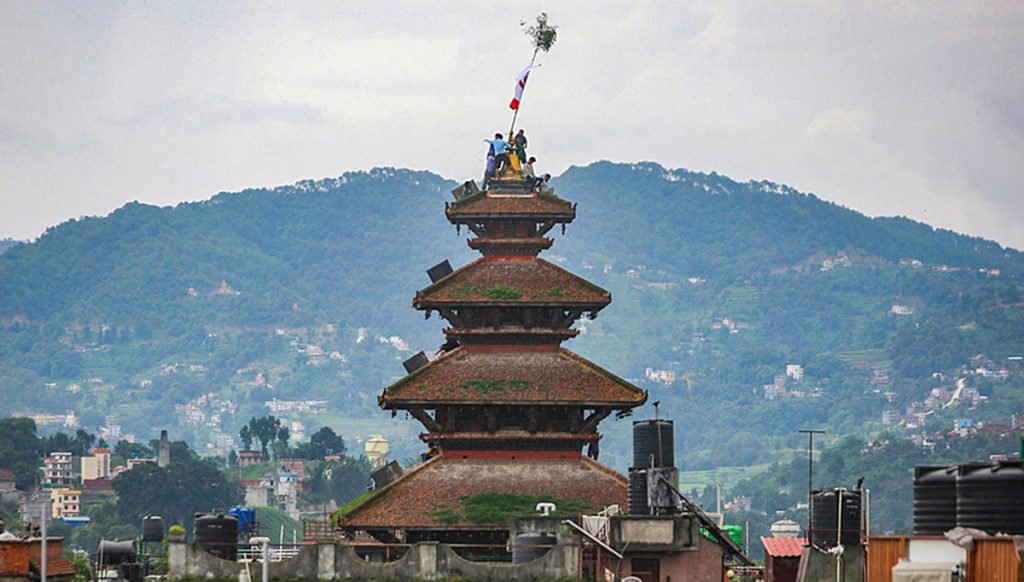
Since it is not open to the common people, the opening of this temple is very rare. Once, on the Ashadha Shuklaparevathiti, on the same date, a goat is sacrificed there. Along with that, a symbolic flag is placed on its peak. Several people watch this kind of work. This work is very risky.
Nevertheless, they do it with great joy and faith. This worship is known as Varshabandhan Puja.
Which deity is present in the Nitāpol temple?
The powerful Tantric goddess, Siddhi Lakshmi, is inside the temple.
Nyatapole mandir Bhaktapur video
Who founded Nitāpol?
When we talk about the Malla kings of Bhaktapur, the first name that comes to our mind is King Bhupatindra Malla. Isn’t it? Probably because of the statue of King Bhupatindra Malla in front of the golden gate of Durbar Square.
Here are some of our works. Please read them.
Related Posts
Recent Posts
-

Amazing Pashupatinath Temple Guide: Timing, Entry Fee & Travel Tips 2026
Mar 17, 2026 | Umesh Thapa
-
India’s Ceramic Tile Industry: Growth, Innovation, Exports, and Future Opportunities
Mar 02, 2026 | Umesh Thapa
-
What Is the Indian Legend Regarding the Discovery of Tea?
Mar 02, 2026 | Umesh Thapa
-
Budget Travel Tips for Expensive Cities USA: How to Explore Without Overspending
Mar 01, 2026 | Umesh Thapa
-
Top 5 Best Visiting Places in Nepal (2026)
Feb 28, 2026 | Umesh Thapa


Popular Posts
-

-

Discover Manungkot: A Hidden Gem in Nepal
Sep 06, 2025 | Umesh Thapa 649 views -

Annapurna base camp trek
Nov 02, 2025 | Umesh Thapa 410 views -

Pathivara Mata Temple Travel Guide 2026 (Trek Distance, Cost & Route)
Oct 29, 2025 | Umesh Thapa 393 views -

Ghyangswara Park: The Ultimate Peaceful Nature Destination in Nepal
Oct 15, 2025 | Umesh Thapa 341 views